Projects on Networking Routing and Switching

This article is mainly focused on defining the routing and switching, i.e., the challenges that a researcher must know before to do projects on networking routing and switching. Routing and switching are fundamental terms that are used for network communication purposes. The routers can achieve the procedure of routing, and switches do the way of switching. Both routing and switching transmit the data packets from the source to the end path.

“Routing and switching are the twin kids of network communication, as switching is done in seconds of interval than routing.”

Though it is designed to provide different functions in the network’s communication process, they can afford services like video conferencing and IP voice by enabling access to some progressive applications.’

What is Routing and Switching in networking?

Though routing and switching are the same devices for data transmission, the switch transmits the data between the devices that belong to one LAN (Local Area Network), but routing transmits data to different LANs. But the purpose of routing and switching are the same to serve as the fundamental network communication tasks.
Performance Metrices of Network Routing and Switching

What is the difference between routing and switching?

Both the router and switch are devices used to connect the network. Routers are responsible for discovering shortcuts for data transmission at the layer of the network and switch links to the variety of devices involved in a network. Before implementing projects on networking routing and switching, one must come to know about its advantages and disadvantage.

What is the Key Advantage of Routing?

  • Routers can lessen the network traffic by generating domains of broadcast and collision
  • Routers utilizes dynamic routing algorithm to be the best in choosing a path through the internet
  • Routers have the capacity to connect the various network patterns like token ring and Ethernet etc.
  • The trait of the router is to keep a schedule on the destination to determine sending the packets to the appropriate IP address of the endpoint.

By the mentioned action, routers are worth the convenient preference, whereas the switches can be able to “function at the second layer of the OSI model.” Here are the key advantages of switches.

What is the Key Advantage of using Switching?

The switch generates a structure from the bits same as the received signal of the switch. By the above action, it could get access to the destination address and reads it as it transfers the structure to the correct port. As an alternative process of broadcasting the structure to all ports, the above function is considered better.

Types of switching

  • Message switching: it directs a complete source node message and transmits from one switch to another to reach its node of the target.
  • Circuit switching: inaugurates a communication route between network nodes that are committed to ensuring the amount of entire bandwidth for transmission and clears data traffic
  • Packet switching: splits the data into free elements and minimizes its size to make less stress to the network. The mobility of the packet extends through its endpoint. On your understanding of the switching,

You can learn

  • To complete the necessity of IPV4 and IPV6 network by the application of subnet, its estimation, and designing
    • To define the importance of protocol layers in data networks with proper understanding
    • To recognize the services and devices used in data networks supporting communication with proper functions of routing and switching.

To know the ruling efficiency of the switches and links in the upcoming days, you need to know the developing technologies behind the circuit switches and routers, which make you clear on predicting the occurrence of blockage in the routing path. Let’s see a router’s data path because a circuit switch’s data path is its subsection. A router and switch has to function by facing the following challenges,

Challenges of Network Routing and Switching

Below we have mentioned some challenges faced in developing Projects on Networking Routing and Switching. If you like to know more details reach our expert panel team.

  • Cost and Performance issues: usually, the routers are unable to contend with layer two switches in terms of performance and cost. The MAC (Media Access Control) is faster when comparing to the layer three switching by the router’s network address. Thus, layer two switching is preferred because of the slowness of layer three switching.
  • Variable and High latency: Usually, the routers cannot support the time-sensitive applications as the routers naturally produce high relative and variable latency.
  • Packets forwarding and Processing: this process is done by electronically specified network workstations like FPGA, ASIC, etc. for the function of the packets to drive from ingress port to the egress port without any mess, and the packets should be programmed first to use the internal interconnect and the routers must be updated to effectively send the next packet to the end address or to place the packet in the queue to buffer.
  • Packets sending and receiving: as we discussed above, the routers send the packets shortly through the egress port as it receives the packets by its ingress port. To attain a high speed of data transmission, fiber optics are used, and the mid-to-low speeds can be done by copper cables.
  • Buffer packets: the regulations of routers that generally require the buffer worth the reproduction of the Link Rate and the Round Trip Time of the way the TCP works the tool of flow control. Like serving as an output port, the packets are coped for income. When the contention of one packet has cleared, the other clashes are cleared by submitting the transmission of all the packets.

For example, if a router the minimum packet size of the router is 40 bytes, the packets could arrive separately in the time of 8ns. But the designers send the packet at a speed 10 Gbps, as a challenging task, where sending a packet of 40 Gbps is even more challenging. In addition, the power-consuming would be an issue as mostly the router has limited availability of memory. But we found some fast Dynamic RAM (DRAM) and Static RAM (SRAM) enables the router to have capacity requirements.

What are the Requirements of Effective Network Routing and Switching?

  • Innovative applications required to have the ability of the accessible Input of  increasing extensive individuals
  • To assimilating the sensors and actuators at the runtime exposition, Extensive Software Platforms are required to meet such skills
  • Appropriate network environment with parameter settings.

To succeed easily manageable organization and fast network to act, a proper simulation of the routing and tasks of switching is needed. But the combined methodology, i.e., switching and routing, has some limitations as follows

Limitations of Switching and Routing Integration

  • Unable the router to manage easily without registration
  • Utilizes biased advantages of switching and routing potential synergy

How does a Router and Switch Work Together?

To be precise, a router serves as a source, which helps in linking the networks of multiple divided positions or linking networks inside an organization. Switches permit communication of varied devices on a system, while the routers let networks for communication.

You must be aware of the functions of circuit switches and packets to realize the paralleling them to multiple routers and switches. Let’s look at the network node includes the roles of projects on networking routing and switching. Numerous novel technologies have to be implanted for the gratification of transmission.

Emerging Technologies on Network Routing and Switching

  • Effects of Networks and 5G radios supporting new applications
  • Tunings of 5G radios and networks, simulation platform, field-try and prototypes
  • Expose next-generation core architecture, network slicing, NFV, SDN
  • Carefree transmission, mobile backhaul, sidelink, immense MIMO, cloud radio access network, manifold TRPs, Ultra-dense network
  • Next-generation Wi-Fi Equipment, 802.11ah, 802.11ay, 802.11ad and IEEE 802.11ax.
  • URLLC, mMTC, eMBB, handling interference and radio assets, radio access based on beamforming, Multi-user Superposition Transmission, NOMA, new waveforms

As we discussed earlier, routing enables communication between networks, and switching enables the wireless communication between devices on a network. Here we provide you the comparison criteria useful for your reference for your projects on networking routing and switching, and it is used to evaluate the function of the network involves in routing and switching while transmitting data on the following basis.

Research-Projects-On-Networking-Routing-And-Switching

Comparison Criteria for Networking Routing and Switching

  • Communication originator
    • On the basis of sensor node source
    • Based on destination
  • Launching path
    • hybrid
    • focused by routing table (proactive)
    • focused by routing request (reactive)
  • Structuring Network
    • Focuses on data
    • Focuses on location
  • Mode of distribution
    • Real time distribution
    • Non real-time distribution
  • Type of application
    • Concentrated by time
    • Concentrated on Incident / events

Based on the functional variance of the routing and switching over a specified network, the output may vary in accordance with the routing and switching process. To get an approximate accuracy over the function of the network, here we provide you some performance metrics that can be useful for your projects on Networking routing and switching.

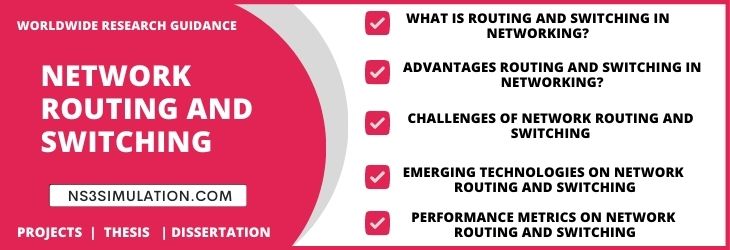
Performance Metrics Projects on Network Routing and Switching

  • Utilization of stress: it is used to calculate the performance of the network in consumption and accessed sources from the allotted total source
  • Level of isolation: this evaluates the performance of network in isolating the lowermost level of virtualization from the physical level of resource.
  • Length of virtual entity path: this metric evaluates the number of hops taken by the network in the physical link to structure a virtual direct link
  • Delay between virtual entities: it measures the amount of transmission delay in the network done by the packet transporting from one virtual node to another
  • Throughput between virtual entities: calculates the number approximate packets transmission between the individuals involved in networks
  • Service Latency and Signaling Delay: this metric used to evaluate the time of delay taken for transmission by both the packet and signal.
  • QoS metric: analyzes the service quality gained by the users over a specified network
  • Energy efficiency: calculates the Throughput energy used by the a network
  • Spectrum efficiency: computes the ability of the wave size used in the specified exposure zone transmitted by the network.
  • Deployment efficiency: evaluates the cost required to get a networking device.
  • Capacity: analyzes the highest packet transmission done by the network on a specified area.
  • Coverage: estimates the enclosed zone served by wireless networks
  • Revenue: calculates the income provided by a network in data transmission
  • Cost metrics: it includes the charge of getting CapEx and OpEx for networking purposes

Every field related to the network involves the process of metrics to evaluate its functions, efficiency and the future scope of the introduced mechanism will be decided by such metrics in order to compare one with the other. So, doing network security projects in the relevant field is also determined by the metric analysis. If the domain is evaluated by low metrics, you cannot find points to elaborate its functions, and you don’t be able to justify your topic. We provide you only the innovative ideas for projects on networking routing and switching suggested by our research team as follows.

Research Ideas on Networking and Routing

  • Network Service Chaining
  • Scheduling bandwidth
  • Virtualizing the function of network
  • Ability to programming network
  • Consumption of resource
  • Security
  • Organizing network
  • Managing energy used in network

We insist you choose our organization of world-class engineers and researchers with our quality assurance on your projects on networking routing and switching. You can join us at any level of our network projects, as we provide on-time delivery to cater to your expectations. Working on your project with us will provide you a fantastic subject and project experience. We ensure your expected project outcomes, and we have more than 200 happy customers in this particular network domain projects. Overall we have 5000+ happy customers, and we are spreading our branches worldwide across 120 countries. So we notify you not to miss the opportunity to have a professional experience.


Assignments Support


  • OMNET++ Assignments
  • NS3 Assignments
  • Ns2 Assignments
  • COOJA SIMULATOR Assignments
  • CONTIKI OS Assignments
  • MININET Assignments
  • OPNET Assignments
  • QUALNET Assignments
  • GNS3 Assignments
  • NetSim Assignments
  • Matlab Assignments
  • Python Assignments

You’re Hub for Diverse Network Simulators Network Simulators Network Simulators

NS3 Services

We Provide

  • NS3 Coding
  • NS3 Simulation Services
  • NS3 Simulation Results
  • NS3 Modeling
  • NS3 Code Implementation
  • NS3 Designs
  • NS3 Research
  • NS3 PhD Guidance
  • NS3 Assignments
  • NS3 Homework
  • NS3 Projects
  • NS3 Thesis
  • NS3 Simulation Services
  • NS3 Simulation Help
  • NS3 Simulation Writers

Writing Services

We Provide

  • Research Proposal
  • Simulation / Results
  • Paper Writing
  • Paper Publication
  • Thesis Writing
  • MASTER Thesis
  • Dissertation Writing
NS3 Research

Get Expert Advice. Instantly.

Powering your research with expert end-to-end support for ns-3 simulation projects.

Helping 1M+ Research Scholars
Research Topics Project Paper Thesis
3D Underwater WSN 150 499 541
Hybrid Beamforming 110 398 432
Intelligent Agent WSN 135 412 510
Blockchain technology 121 467 496
Optical Networks 149 398 465
Vehicular sensor Network 250 491 534
Industrial IoT 114 378 431
Service Discovery 170 419 489
Named Data Networking 121 386 423
SDN-NDN 110 427 498
D2D Communication 131 389 425
M2M Communication 108 389 411
UWB communication 124 495 510
5G Network Slicing 137 437 492
Delay Tolerant Network 105 469 533
Multi-Microgrid 111 326 379
Content-centric network 100 296 304
5G Beyond networks 131 379 409
Cloud-RAN 127 352 389
Fog-RAN 145 310 378
FANET 178 395 400
Cognitive adhoc network 153 325 363
Vehicular NDN 175 310 425
Multimedia sensor network205 275 315
V2X communication 151 200 308
Software-defined WSN 176 248 358
5G 201 289 365
Fibre Channel / Cellular / 5G topics
Cellular Networks 185 235 397
CRN 204 268 348
IoT 163 287 395
Intrusion Detection system110 257 348
LiFi 101 279 386
LTE 159 208 345
MANET 175 247 395
MIMO 142 298 354
Mobile Computing 114 254 308
RPL 189 275 357
SDN 109 258 346
VANET 152 278 359
Vertical Handover 108 241 367
Wireless Body Area Network121 198 348
Wireless Communication 178 248 371
Wireless Sensor Networks106 213 369
NS3 Research
Professional guidance and complete assistance for your ns-3 simulation research and development.

Complete NS-3 Simulation Support

Contact

End-to-End Project Assistance

From Topic selection to Final submission support.

Code Debugging & Error Fixing

Fix build errors, runtime issues, and simulation crashes.

Scenario Design & Custom Topologies

Create real-time research-based network scenarios.

Performance Optimization

Improve simulation efficiency and execution time.

Thesis & Journal Paper Support

Help with result interpretation, graphs, and documentation.

Online Demo & Explanation Support

Project explanation for viva, review, and presentations.

Computer Networking Domains

  • Wireless Sensor Networks (WSN)
  • Mobile Ad-hoc Networks (MANET)
  • Vehicular Ad-hoc Networks (VANET)
  • Internet of Things (IoT)
  • 5G Networks
  • 6G Wireless Communication
  • Software Defined Networking (SDN)
  • Network Function Virtualization (NFV)
  • Cognitive Radio Networks
  • Wireless Mesh Networks
  • Delay Tolerant Networks (DTN)
  • Underwater Sensor Networks (UWSN)
  • Body Area Networks (BAN)
  • Smart Grid Communication
  • Satellite Communication Networks
  • LTE/4G Networks
  • Mobile Communication Systems
  • Edge Computing in Networking
  • Fog Networking
  • Cloud-based Network Architecture
  • Green Networking
  • Opportunistic Networks
  • Multicast and Broadcast Routing
  • Network Topology Design
  • Network Performance Analysis
  • Network Simulation and Modeling
  • Network Protocol Design
  • Wireless Multimedia Sensor Networks
  • Routing Protocols (AODV, DSR, OLSR, etc.)
  • QoS in Wireless Networks
  • Mobility Models in Networks
  • Cross-layer Optimization
  • Antenna Design & Beamforming
  • IoT-enabled Healthcare Networks
  • LPWAN (LoRa, Sigfox, NB-IoT)
  • Millimeter-Wave Communication
  • MIMO Systems
  • VANET Security
  • Network Traffic Management
  • Congestion Control Mechanisms
  • Spectrum Allocation & Management
  • Smart City Communication
  • Multi-hop Networks
  • IoT Device Communication
  • Wireless Interference Management
  • Satellite-IoT Integration
  • Multi-RAT (Radio Access Technology) Networks
  • Hybrid Networks
  • Dynamic Spectrum Access
  • Intermittently Connected Networks

Cybersecurity Domains

  • Network Security
  • Cyberattack Detection
  • Intrusion Detection Systems (IDS)
  • Intrusion Prevention Systems (IPS)
  • Distributed Denial-of-Service (DDoS) Mitigation
  • Firewall Architecture and Design
  • Security in IoT Networks
  • Authentication and Access Control
  • Blockchain for Network Security
  • Data Encryption Techniques
  • Wireless Security Protocols
  • Secure Routing in Ad-hoc Networks
  • Trust Management in Networks
  • Cyber Threat Intelligence
  • Honeypots and Honeynets
  • AI-Based Threat Detection
  • Zero Trust Security Architecture
  • Malware Detection and Analysis
  • Cloud Security
  • Fog and Edge Security
  • Deep Packet Inspection
  • Privacy Preservation in Networking
  • Steganography in Network Communication
  • Cyber Forensics
  • Risk Assessment and Vulnerability Analysis
  • Secure IoT Communication
  • Botnet Detection in Networks
  • Phishing Attack Prevention
  • Insider Threat Detection
  • Identity Management Systems
  • Cryptographic Protocols
  • Public Key Infrastructure (PKI)
  • Secure Network Virtualization
  • Web Application Security
  • Wireless Intrusion Detection
  • Adaptive Security Mechanisms
  • SDN-Based Network Security
  • Anomaly-Based Detection Systems
  • Secure Group Communication
  • Ransomware Protection
  • DNS Spoofing and Protection
  • Man-in-the-Middle (MITM) Attack Defense
  • Security in SCADA Networks
  • IoT Botnets and Countermeasures
  • Threat Modeling and Simulation
  • Biometric Authentication in Networks
  • Secure Firmware Updates in IoT
  • Endpoint Detection and Response (EDR)
  • Data Loss Prevention (DLP) in Networks
  • Secure Wireless Mesh Networks

Network Communication Domains

  • Channel Allocation Strategies
  • MAC Layer Protocols
  • Medium Access Control in WSN
  • TDMA, FDMA, CDMA-Based Communication
  • Wireless Interference Modeling
  • Traffic Engineering in Networks
  • Cross-Layer Communication Design
  • Signal Propagation Models
  • Network Coding Techniques
  • Multicast Communication
  • Multi-Channel Communication
  • Hybrid Communication Models
  • TCP/IP Performance Tuning
  • Adaptive Data Transmission
  • Smart Antenna Communication
  • Cooperative Communication
  • Delay-Tolerant Communication
  • Real-Time Data Transmission
  • Context-Aware Communication
  • Ultra-Reliable Low Latency Communication (URLLC)
  • Energy-Aware Communication Protocols
  • Congestion-Aware Routing
  • Communication Overhead Optimization
  • Link Reliability Analysis
  • Node Communication Scheduling
  • Cluster-Based Communication
  • Latency Optimization in Networks
  • Bandwidth Management Techniques
  • Fault-Tolerant Communication Systems
  • Communication in Smart Homes
  • Mobile-to-Mobile Communication
  • Wi-Fi Offloading Techniques
  • Dynamic Topology Control
  • Sensor-to-Base Station Communication
  • Communication in Swarm Robotics
  • Time Synchronization in Wireless Networks
  • Mobility-Driven Communication
  • Real-Time Streaming over Networks
  • Network Communication in Drones (UAVs)
  • Multi-Hop Relay Communication
  • Heterogeneous Network Communication
  • Device-to-Device (D2D) Communication
  • Application Layer Protocols
  • Cognitive Communication Systems
  • Energy Harvesting Communication
  • Full Duplex Communication
  • Multimodal Network Communication
  • Autonomous Vehicle Communication
  • Communication in Disaster Recovery Networks
  • Reliable Data Broadcasting in Wireless Networks

Your Trusted Your Trusted Your Trusted NS-3 Research Companion

Your one-stop solution for NS-3 protocols, routing strategies, and parameter optimization—fully tailored to your research needs.

  • Physical Layer
  • Data Link Layer
  • Network Layer
  • Transport Layer
  • Session Layer
  • Presentation Layer
  • Application Layer
  • Traffic Analysis Attack
  • Sniffer Attack
  • SS7 Attack
  • DDoS
  • Spoofing Wireshark
  • Ping Sweep Attack
  • Packet Injection
  • Network Probe Attack
  • ICMP Attack
  • ICMP Redirect Attack
  • Passive Attacks
  • Botnets
  • Eavesdropping Attack
  • Wireless Attacks
  • Internet Attacks
  • Hello Flood Attack
  • Hping3 SYN Flood Attack
  • Intrusion Attacks
  • Active Attacks
  • Password Sniffing Attacks
  • Packet Flooding Attack
  • Birthday Attack
  • Fragmentation Attack
  • Ransomware Attack
  • Firewall Attack
  • Teardrop Attack
  • Masquerade Attack
  • Quench Attack
  • Bus Topology
  • Star Topology
  • Ring Topology
  • Mesh Topology
  • Tree Topology
  • Hybrid Topology
  • Point-to-Point Topology
  • Point-to-Multipoint Topology
  • Daisy Chain Topology
  • Fully Connected Topology
  • Partial Mesh Topology
  • Extended Star Topology
  • Hierarchical Topology
  • Line Topology
  • Circular Topology
  • Grid Topology
  • Cellular Topology
  • Cluster Topology
  • Peer-to-Peer Topology
  • Overlay Topology
  • Logical Topology
  • Physical Topology
  • Wireless Mesh Topology
  • Fibre Channel Arbitrated Loop (FC-AL) Topology
  • Token Ring Topology
  • Dual Ring Topology
  • Flat Topology
  • Mixed Topology
  • Zigbee Topology
  • Network-on-Chip (NoC) Topology
  • Switched Mesh Topology
  • Irregular Topology
  • Bus-Star Hybrid Topology
  • Hierarchical Star Topology
  • Ring-Mesh Hybrid Topology
  • Star-Bus Hybrid Topology
  • Extended Bus Topology
  • Wireless Topology
  • Bluetooth Topology
  • Fiber Optic Topology
  • Network traffic analysis
  • Network Routing
  • Network designs optimization
  • Network Topology
  • QoS Attainment
  • QoE Attainment
  • Physical layer technologies
  • Network Security Analysis
  • Multi-RAT
  • AP Selection
  • Delay Assessment
  • Packets Transmission
  • Mobility Handoff Management
  • Mobility Management
  • Distributed Systems
  • Energy Management
  • Channel Equalization
  • Trust model
  • Clustering
  • MAC protocol design
  • 3D Beam alignment
  • Blockage mitigation
  • Offloading
  • Data fusion
  • Bundling protocols
  • DTN data management
  • DTN architectures
  • DTN prototypes
  • Network Content Sharing
  • Data Synchronization
  • Trust Models Design
  • IP Addressing
  • Namespaces
  • PID Management
  • Rendezvous, Discovery
  • Bootstrapping
  • Data Transmission Privacy
  • Social Network Analysis
  • Ransomware Target
  • StableBitcoins
  • Interoperability
  • Consensus Protocol Design
  • Protocol Optimization
  • Lightweight Blockchain Design
  • VNFs Orchestration
  • Containerized Services
  • Quantum Communication
  • Physical Layer Communication
  • NFV Communication
  • Scalability Improvement
  • Network Softwarization
  • Interact Different Networks
  • Fusion of Fronthaul
  • Backhaul
  • Small Cell Nets
  • Allocation in HetNets
  • slicing HetNets
  • Interoperability B5G
  • Coexistence of OFDMA
  • NAMO
  • Traffic differentiation
  • Traffic Offloading
  • M2M Radio Link
  • Mesh Communication
  • Sensor Management
  • Device Management
  • Spectral Efficiency
  • Network Resource Allocation
  • Cross Layer Design
  • Multimedia Transmission
  • Next Generation
  • Channel Rate Adaptation
  • Multi-Hop Energy
  • Flying Vehicle Communication
  • Submarine Data Transmission
  • Visual MIMO
  • Large-Scale Networks
  • mmWave
  • Node Deployment
  • OSI layers Security
  • Trust based Routing
  • Reputation based Routing
  • Network Port Access
  • Multi-level Firewall
  • En-Route Filtering
  • End-to-End Encryption
  • Radio Fingerprinting
  • Scalable Parameterization
  • Channel Interference Avoidance
  • Radio Resource Allocation
  • Frequency Hopping
  • Data Suppression
  • Data Compression
  • Beamforming
  • Multimedia Routing
  • Cell Sectorization
  • Satellite Constellations 5G
  • Satellite Constellations B5G
  • AI based Resource Allocation
  • Energy Harvesting
  • Energy Consumption
  • Route Readjustment
  • Path Prediction
  • Mobile Sink Location
  • Relocation
  • Intelligent Agents Deployed
  • 3D Wireless Sensor Modeling
  • 4D Wireless Sensor Modeling
  • 6TiSCH Sensors Communication
  • TSCH based Sensors Communication
  • New Waveform
  • Channel Modeling
  • Spectrum Allocation
  • Energy Harvesting in URLLC
  • Energy Harvesting eNBB
  • Security Preservation
  • Bio-Inspired Routing
  • Deep Learning based Routing
  • Route by Hybrid Protocols
  • Routing Protocols Design
  • Multi-Criteria based Routing
  • Network Structure
  • Topology based Routing
  • MIMO Routing
  • Hybrid Beamforming
  • Interference Management
  • Channel Characterization
  • Pilot Contamination
  • 3D Channel Modeling
  • HD Video Streaming
  • Mobile Data Networking
  • Carrier Aggregation
  • Channel Aggregation
  • Packet Scheduling
  • Scheduling Cell Resource
  • Uplink Synchronization
  • Downlink Synchronization
  • QoS aware Routing
  • QoS aware Clustering
  • 3D MANET Massive Users
  • 4D MANET Massive Users
  • Interoperability to D2D
  • Interoperability Cloud
  • Interoperability 5G
  • MANET-IoT
  • Massive Channel Access
  • H&off Management
  • Video Traffic Scheduling
  • Secondary Users Routing
  • PUEA Detection
  • Spectrum & Power Allocation
  • Error Control & Fault Prediction
  • Dynamic Spectrum Access
  • Channel Scheduling
  • Channel Sensing
  • Relay Selection
  • Power Allocation
  • Coverage Improvement
  • Capacity Improvement
  • Power allocation
  • scheduling
  • Content Dissemination
  • VSN
  • Mobile Sensing
  • Network Collision Avoidance
  • Traffic Congestion Info
  • Systems on a chip
  • Optical fibers
  • line switching
  • Passive optical networks
  • Rapid fault handling
  • Optics in 5G networks
  • Satellite optical
  • Low earth orbit satellite
  • M2M satellite communication
  • Heterogeneous satellite-cooperative
  • Hybrid satellite terrestrial relay network
  • Inter-satellite Optical communication
  • DWDM in Fiber
  • Packet Switching
  • Optimal Routing
  • Optical Visual MIMO
  • Burst Loss Probability
  • Flexible Branching
  • Path planning AUV
  • cluster transmission
  • Prediction sensor location
  • Range Free Localization
  • Gateway Placement
  • Mobility Control
  • Adjustment of power
  • Demodulation
  • ISI mitigation
  • Reactive obstacle prediction
  • Localization schemes
  • Channel coding
  • Aggregation
  • Co-channel interference
  • Nearest Antenna Selection
  • Spatial Modulation
  • PAPR Mitigation
  • Multiple Access
  • Filtered OFDM
  • MAC Frame Design
  • In-body, On-body & Off-body
  • Emergency Data Prediction
  • Remote Patient Monitoring
  • Energy Aware Resource Allocation
  • Power Optimized Data Transmission
  • Flow Rule Placement
  • Multimedia Flows Routing
  • Buffer Management
  • Network Traffic Analysis
  • Dynamic Offloading
  • Controller Placement
  • Emergency Message Dissemination
  • Vehicle Traffic Analysis
  • Network Penetration Testing
  • Security Information and Event Management
  • Network Threat Intelligence
  • Task Offloading Decision
  • Traffic aware Routing
  • Network Privacy
  • DODAG Fault Tolerance
  • Network Traffic Balancing
  • Traffic Control
  • Congestion Control
  • Mobility Control
  • Network Incident Response
  • Service Discovery
  • Network Design and Architecture
  • Network Management
  • Network Performance Analysis
  • Network Monitoring
  • Network Troubleshooting
  • Network Privacy
  • Network Anonymity
  • Network Secure Shell
  • Network Telnet
  • Video Conferencing
  • Network Telepresence
  • Collaboration Tools
  • Network Cloud Storage
  • Network Wireshark Analysis
  • Network Packet Tracing
  • Network Business Continuity
  • Network Traffic Shaping
  • Autonomous Network Management
  • Internet Governance
  • Secure Multi-Party Computation
  • Network Service Chaining
  • Network Slicing
  • Network Microsegmentation
  • Network Coding
  • Cross Layer Design
  • Network Neutrality
  • Network Edge Intelligence
  • Machine Learning for Network Optimization
  • Network Analytics
  • Network Digital Twins
  • Network Service Orchestration
  • Network Policy Based Management
  • Network Intent Based Networking
  • Virtualized Security
  • Ransomware Detection
  • Anti-forensic Techniques
  • Malware Detection
  • Virus Detection
  • Access Control
  • Privacy Control
  • Insider Threat
  • Intrusion Detection
  • Attacks Mitigation
  • Node Authentication
  • Behavioral Detection
  • Multi-Attacks Detection
  • Threats Analysis
  • Multi-Factor Authentication
  • CoC Preservation
  • Types of Forensics
  • Refine Forensics Architecture
  • SDN Forensics
  • IaaS Cloud Forensics
  • Lightweight Architecture
  • Public Key Cryptography
  • Symmetric Key Cryptography
  • Identity based Cryptography
  • Certificateless Cryptography
  • Cryptographic Hashing
  • Lightweight Cryptography
  • Fiber Optical Security
  • ANN based Steganography
  • Internet Traffic Transforming
  • Blockchain based IDS
  • Anomaly based IDS
  • Hybrid Signature
  • Retraining Massive Data
  • Source Location Privacy
  • Phishing Defense
  • Network Disaster Recovery
  • Network Security Architecture
  • Network Security Engineering
  • Network Security Operations
  • Network Security Awareness
  • Network Cybersecurity Frameworks
  • Network Cybersecurity Policies
  • Network Cybersecurity Compliance
  • Network Cybersecurity Auditing
  • Network Threat Hunting
  • Network Penetration Testing Methodologies
  • Network Vulnerability Assessment
  • Network Risk Assessment
  • Network Security Posture
  • Security Metrics
  • Industrial Control Systems Security
  • SCADA Network Security
  • Data Security
  • Privacy Protection
  • Application Security
  • Web Security
  • Mobile Security
  • Cloud Security
  • Endpoint Security
  • Identity and Access Management (IAM)
  • Zero Trust Security
  • Secure Coding Practice
  • Antivirus and Anti-malware
  • Security Architecture
  • Advanced Persistent Threats
  • Cyber-Physical Systems Security
  • Industrial Control Systems Security
  • SCADA Security
  • IoT Security
  • Bring Your Own Device Security
  • Blockchain Security
  • Quantum Cryptography
  • Autonomous Vehicle Security
  • Cybersecurity in Healthcare
  • Cybersecurity in Finance
  • Cybersecurity in Education
  • Cybersecurity in Government
  • Cybersecurity in Retail
  • Cybersecurity in Telecommunications
  • Artificial Intelligence Security
  • Machine Learning Security
  • Cybersecurity in Big Data
  • Cybersecurity in Cloud Computing
  • Cybersecurity in Edge Computing
  • Fog Computing Security
  • Serverless Computing Security
  • Cybersecurity in 5G Networks
  • Wireless Security
  • Security in E-Commerce
  • Security Incident Management
  • Insider Threat Management
  • Cyber Espionage
  • Cyber Warfare
  • Cybersecurity in Supply Chain Management
  • Cybersecurity in Manufacturing
  • Cybersecurity in Renewable Energy Systems
  • Embedded Systems Security
  • Firmware Security
  • Biometric Security
  • Mobile Application Security
  • Next-Generation Firewalls
NS3 Worldwide Support

Enquire Now